Updated 19 October 2026 (Kartik 2, 2083). Rules come from the Startup Enterprise Loan Program Operation Procedure, 2082 and the ministry's notices; dates and figures from IEDI's notices as reported by Nepali news outlets. IEDI's website was down when we checked, so confirm the current notice there before acting.
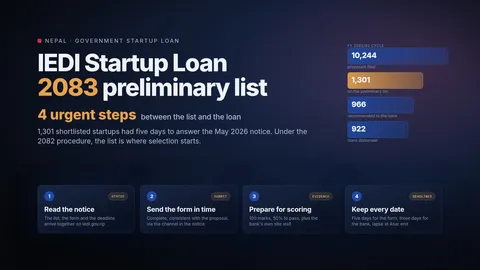
On Friday 1 May 2026 (Baisakh 18, 2083), the Industrial Enterprise Development Institute (IEDI) published the IEDI startup loan 2083 preliminary list: 1,301 projects picked from 10,244 proposals. The notice came with a catch. Everyone on the list had until 5 pm on Baisakh 23 (6 May), five days later, to send a filled business-details form by WhatsApp, and any proposal that missed the window would be automatically invalid, Onlinekhabar reported.
That is why "preliminary list" and "disqualification" sit in the same search. A place on the list is the start of the hardest stretch of the process, not the finish.
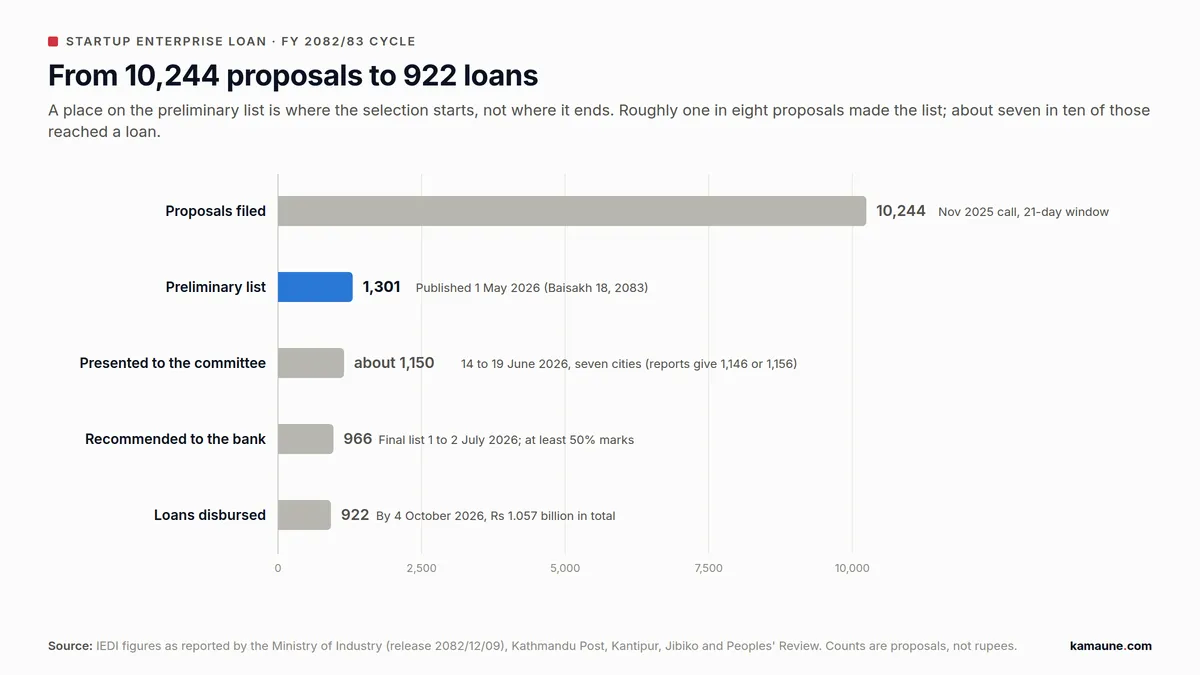
One thing to be clear about first. The list published in Baisakh 2083 belongs to the fiscal year 2082/83 cycle, which opened for proposals in November 2025. That cycle is closed: 966 projects were recommended to the bank in July 2026, and by early October IEDI said 922 startups had received Rs 1.057 billion, Peoples' Review reported. As of 19 October 2026 we could not verify any call for proposals, or any preliminary list, for the fiscal year 2083/84 cycle. The budget for it exists (Rs 80.85 crore, Onlinekhabar), and last year's call came on Kartik 19, so the next one could appear any week. The steps below are written so you can act on it the day it does.
What Is the IEDI Startup Loan 2083 Preliminary List?
The Startup Enterprise Loan is the government's 3% interest, collateral-free loan of Rs 5 lakh to Rs 20 lakh for innovative startups, run by IEDI under the Ministry of Industry, Commerce and Supplies (MoICS) and disbursed through Rastriya Banijya Bank. The rules sit in the Startup Enterprise Loan Program Operation Procedure, 2082, amended once on Asoj 31, 2082 (first amendment). Our startup loan guide for Nepal covers the scheme's terms; this article is about the selection stage.
Section 12 of the procedure sets the order of play. After proposals close, IEDI publishes a sector-wise list of everything registered, then a preliminary list of proposers who meet the Section 4 eligibility tests, then a presentation schedule, and finally scores each proposal. So the preliminary list answers one question: does this enterprise qualify on paper? It says nothing yet about marks, loan amount or the bank's view.
For the 2082/83 cycle the ministry described the screening in a release dated Chaitra 9, 2082 (22 March 2026): an expert committee per sector, "AI-based screening software" for the first pass, and field checks by Enterprise Development Facilitators at local governments, who sent a form, photos and a roughly one-minute video of each enterprise. Only after those reports came in was the list of 1,301 published.
Preliminary selection does not guarantee a loan. The 2082/83 numbers show the funnel:
When the list appears, read the notice attached to it for four things: whether your project is on it (by firm name and registration details, as entered in the proposal), what you must submit next, by what channel, and the exact date and time. The authentic list and notice are published only on iedi.gov.np; the procedure also requires IEDI to inform proposers by phone or SMS on the number in the proposal (Section 13(8)).
4 Urgent Steps to Avoid Disqualification
The four steps mirror what the 2082/83 notices actually required. Where a requirement comes from the procedure we say so; where it comes from one cycle's notice, treat it as a pattern to expect until the new notice confirms it.
1. Check Your Selection Status and Official Notices
What to do. Open the list on IEDI's notice page and search for your firm exactly as registered. Then read the notice text, not just the list. In May 2026 the form, the WhatsApp number and the deadline were all in that one notice, and a link to the form went out by SMS to the mobile number in each proposal, the Kathmandu Post reported.
Why it matters. News sites summarise the notice, and two outlets printed different WhatsApp numbers for the same May notice. The official page is the record.
Do this now. Keep the phone number and email from your proposal active, bookmark iedi.gov.np/notices, and note your registration details so you can find yourself in a 1,300-row list in seconds.
2. Prepare and Submit the Required Documents
What to do. In the 2082/83 cycle the preliminary-list notice asked for one thing: the business-details format, downloaded from the SMS link or the IEDI website, filled completely and sent to the WhatsApp number in the notice by 5 pm on Baisakh 23. Incomplete or late submissions were to be treated as automatically invalid (Onlinekhabar, Kathmandu Post).
Why it matters. What you send is checked against the proposal you filed and the Section 8 documents attached to it (listed in the table below). A false self-declaration about other concessional loans cancels the proposal at any stage (Section 9(4)). Fake documents, false details or staged videos get the enterprise removed from the process and referred for legal action (Section 26).
Do this now. Put every document in one folder and check that the firm name, registration date, turnover and headcount match across all of them and the proposal. Fix any mismatch before the list is out.
3. Prepare for Business Evaluation or Verification
What to do. Know how you will be scored. Schedule 5 of the procedure gives 80 general marks and 20 sector marks:
| Scoring area (Schedule 5) | Marks |
|---|---|
| Current state of the enterprise (registered as a startup, prototype or commercial production, linked to a Business Incubation Centre) | 12 |
| Growth potential (last year's turnover growth, import substitution, market) | 10 |
| Technology adoption | 15 |
| Source of raw materials (fully domestic scores highest) | 10 |
| Business presentation (confidence, knowledge of your own proposal, SWOT) | 6 |
| Bank credit appraisal (repayment record, insurance, at least 50% own investment, financial risk plan) | 15 |
| Employment, existing and proposed | 12 |
| Sector-specific criteria | 20 |
A proposal needs at least 50% of total marks, and the highest scorers are ranked first (Section 13(1)). The committee may ask for extra video or details and may inspect the site if anything looks doubtful (Sections 11(2), 12(5)). The bank then does its own site inspection and returns a credit-appraisal score within ten days (Section 12(3)).
Why it matters. The process can change mid-cycle. In March 2026 the ministry said presentations would be dropped that year in favour of the field reports, photos and videos. In June, IEDI nonetheless called the shortlisted proposers to present in seven cities, from Biratnagar to Dhangadhi, between Jestha 31 and Asar 5 (14 to 19 June 2026). Nearly 1,300 were called and about 1,150 presented, Jibiko and Kantipur reported.
Do this now. Write a one-page summary of the business with last year's sales, your own investment, current and planned jobs, your technology and your raw-material sources, each backed by a document. Keep a short, honest video of the premises ready. Our guide to registering a business in Nepal covers the paperwork the scorers expect.
4. Meet Every Deadline and Respond to Official Communication
What to do. Track three deadlines: the follow-up after the preliminary list (five days in 2083), the presentation date for your city, and the bank deadline after final selection. The procedure gives a recommended proposer 30 days to contact the designated bank, after which the proposal is automatically cancelled (Section 13(9) and (10)). In practice the 2083 final notice, published on 1 and 2 July 2026, gave three days to reach the assigned Rastriya Banijya Bank branch with original documents, because the programme is annual and every recommended amount lapses at the end of Asar (Jibiko, Kantipur).
Why it matters. Of the 966 recommended in July, 922 had loans by October. IEDI has not explained the gap, but the lapse rule and the bank's appraisal are the two places where a recommended project can still fall out.
Do this now. Put every date in a calendar with a reminder two days before. Keep proof of each submission: the WhatsApp delivery screenshot, the SMS from IEDI, the bank's acknowledgement. Answer calls from IEDI and the bank; a missed call is a missed instruction.
Documents to Prepare for the IEDI Startup Loan Process
| Stage | Document | Status |
|---|---|---|
| With the proposal (Procedure, Section 8) | Copies of: registration and renewal certificate; PAN and previous fiscal year's tax clearance; previous year's audit report; authorised representative's citizenship; proof or self-declaration of innovation or technology use; previous fiscal year's staff salary statement | Official requirement |
| With the proposal (Section 9(3)) | Self-declaration that you hold no concessional or startup loan from federal, provincial or local government | Official requirement |
| After the preliminary list (May 2083 notice) | Business-details format, filled and sent by WhatsApp before the deadline | Required in the 2082/83 cycle; confirm in the new notice |
| After final selection (Asar 2083 bank notice) | Originals of registration and renewal certificate, PAN or VAT certificate and citizenship; tax clearance for FY 2081/82; three passport photos of the authorised person; business stamp; lease or rent agreement if the premises are rented; permits from other agencies where the business needs them | Required in the 2082/83 cycle; confirm in the new notice |
| Any stage (advice, not a rule) | One-page business summary, last 12 months of sales records, bank statements, photos and a short video of the premises, quotations for what the loan will buy | Useful to organise in advance |
Do not assume anything beyond the official rows is mandatory until a notice says so.
Common Reasons Startup Loan Applications May Be Rejected
Actual grounds depend on the procedure and the notice for your cycle. These are the ones the 2082 procedure and the 2083 cycle make visible:
- Not a startup under Section 4. Registered after the call notice was published, more than ten years old, turnover above Rs 15 crore in any year, an import-and-resell business, blacklisted, or a holding or investment company.
- A second proposal from the same entrepreneur or household, or an existing concessional loan from another agency (Section 9(2)). A false declaration on either cancels the proposal whenever it is found.
- Missing the follow-up deadline after the preliminary list. The 2083 notice made this automatic.
- Not attending the evaluation. Roughly 150 of those called in June 2026 did not present.
- Scoring below 50%, or above it but below the budget line. IEDI asked for Rs 1 billion and got Rs 730 million for 2082/83, later topped up, the Kathmandu Post reported.
- Unsupported claims. The ministry said field inspection was introduced because earlier applicants had submitted fake videos. Section 26 covers forged papers and false details.
- Not contacting the bank in time, or failing the bank's credit appraisal. The bank can decline to lend if it records its grounds (Section 14(6)).
What Happens After Preliminary Selection?
The verified sequence from the 2082/83 cycle, with the procedure clause where one applies:
- Preliminary list, 1 May 2026, with a five-day window for the business-details form.
- Scoring and presentations. Committee marks on the field reports, photos, videos and documents (Schedule 5); presentations in seven cities, 14 to 19 June 2026.
- Bank credit appraisal by Rastriya Banijya Bank, with its own site visit, within ten days (Section 12(3)).
- Final selection. Committee average plus bank score; 50% minimum; ranked and approved by IEDI's executive director (Section 13). The list of 966, each with an assigned branch, went up on 1 and 2 July 2026.
- Bank stage. Contact the branch in time with originals and sign the agreement. The first instalment, normally 50% of the loan, comes within seven working days; the rest after the bank inspects how it was used. Interest is 3% a year, repayment starts a year after the first instalment, the project itself is the security, and the bank may charge up to 0.15% as a service fee (Sections 14, 15, 18).
- After disbursement. Quarterly progress reports, use of the money only for the proposed purpose, and cooperation with monitoring (Section 20). Default can lead to blacklisting and frozen assets (Section 17).
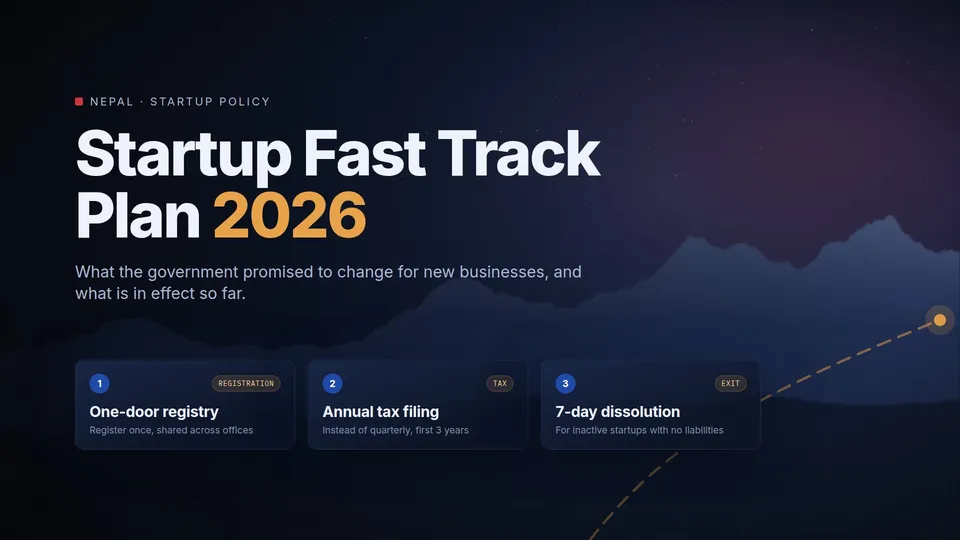
Whether the FY 2083/84 cycle follows the same calendar is not yet known. The government's Startup Fast Track plan promises faster loan processing but has not changed the procedure as of this update.
How to Check Official IEDI Startup Loan Updates
- IEDI notices: iedi.gov.np/notices. Calls, preliminary lists, presentation schedules and the final list with bank branches are all posted here. The site returned an error throughout 19 October 2026; retry rather than relying on a copy elsewhere.
- Online proposal portal: sams.iedi.gov.np, named in the ministry's call notice.
- Ministry notices: moics.gov.np carries the procedure, its amendment and releases, including the call notice of Kartik 2082.
- Gorkhapatra, where IEDI says every call is also printed, and IEDI by phone on 01-5361339 or 01-5361469, as printed on the call notice.
No official stage asks for a fee, and the only WhatsApp number that counts is the one printed in IEDI's own notice.
Frequently Asked Questions
How can I check the IEDI startup loan 2083 preliminary list?
Open the notice on iedi.gov.np, download the list and search for your firm name and registration details as entered in the proposal. IEDI also sends an SMS to the proposal's mobile number. For the 2082/83 cycle the list went up on 1 May 2026 with 1,301 projects.
Does preliminary selection guarantee a startup loan?
No. It confirms eligibility under Section 4 of the procedure. Proposals are then scored out of 100, need at least 50%, pass the bank's credit appraisal and are ranked against the budget. In 2082/83, 1,301 preliminary selections became 922 loans.
What should I do after my name appears on the preliminary list?
Read the notice for the required submission, the channel and the deadline, and send it early. In May 2026 that meant a business-details format by WhatsApp within five days. Then prepare the evidence for scoring and a presentation if one is scheduled.
Which documents are required after preliminary selection?
In 2082/83, only the filled business-details format was required at that stage. Originals of registration, PAN or VAT, citizenship, tax clearance, photos, the business stamp and any lease were required later, at the bank. Check the new cycle's notice before assuming the same.
Can an applicant be disqualified after preliminary selection?
Yes. The 2083 notice said a missed follow-up deadline made the proposal automatically invalid. The procedure also cancels proposals for a false self-declaration (Section 9(4)), fake documents or videos (Section 26), and not contacting the bank in time after recommendation (Section 13(10)).
Where can I find the IEDI startup loan final selection list?
On iedi.gov.np, under notices. The 2082/83 final list of 966 recommended projects, each with an assigned Rastriya Banijya Bank branch, was published there on 1 and 2 July 2026. IEDI must also inform recommended proposers by phone or SMS.
How can I confirm the deadline for the next stage?
Only from the notice itself. Deadlines in this programme have ranged from five days (the May 2026 form) to three days (the July 2026 bank contact). Until IEDI publishes the FY 2083/84 call and its follow-up notices, no deadline for the new cycle can be confirmed.
Conclusion
The IEDI startup loan 2083 preliminary list rewarded the applicants who treated it as an instruction, not an announcement. Four habits carried people from the list to a loan: reading the official notice rather than the summary, submitting complete and consistent details inside the window, preparing evidence for the Schedule 5 scoring and the bank's inspection, and meeting every deadline with proof in hand.
The 2082/83 cycle is finished, and the FY 2083/84 call had not appeared when we checked, so there is nothing to submit yet and no deadline to miss. Use the time to get the documents straight. If you are still deciding what to build, start with our small business ideas for Nepal. Join the Kamaune newsletter to hear when the call opens, and ignore anyone on social media announcing a list that is not on iedi.gov.np.
This article is educational, not financial or legal advice. Rules, dates and loan terms change between cycles; verify them against the current IEDI notice and the procedure on moics.gov.np before acting.