
Say you want to open a cloud kitchen in Butwal. You have priced the equipment, rent deposit and first month of ingredients at about Rs 12 lakh, and you have saved Rs 4 lakh. The first bank you visit asks two questions: what land can you put up as collateral, and how many years has the business been running? You have no land in your name and the business does not exist yet.
That is the real starting point for most people searching for a startup loan in Nepal. Money is available, but lenders here are built to finance businesses that already have assets and a track record. This guide explains what a startup loan is, where new entrepreneurs in Nepal can actually borrow, what the government startup loan scheme offers, and how to prepare an application that a credit officer can say yes to.
Note on figures: interest rates, loan limits, eligibility rules and government schemes in Nepal change often, sometimes every fiscal year. Every figure below is a snapshot as of October 2026 with its source. Confirm current terms with the bank, the implementing agency or Nepal Rastra Bank before you apply.
What Is a Startup Loan?
A startup loan is borrowed money used to start or run a business in its early stage, usually before it has a long revenue history. You repay it with interest over a fixed period, and you keep full ownership of the business.
In Nepal, "startup loan" is used in two ways:
- Any loan for a new business: an SME, micro or project loan from a bank or financial institution, taken by someone starting out.
- The government's Startup Enterprise Loan: a specific, concessional scheme for innovative startups, run by the Ministry of Industry, Commerce and Supplies (covered below).
How a startup loan differs from a traditional business loan
A regular business loan is judged mostly on the past: audited accounts, tax returns, bank turnover and collateral. A startup loan is judged mostly on the future: the business plan, projected cash flow, the promoter's own investment and the founder's ability to run the project. Because the lender carries more risk, it usually asks for a stronger plan, a larger owner contribution or extra security such as a personal guarantee.
Who uses startup loans
- First-time entrepreneurs opening a shop, restaurant, workshop or service business
- Returnee migrant workers investing savings plus a loan into a local enterprise
- Graduates and young professionals launching a tech, agri or manufacturing idea
- Women entrepreneurs using concessional loan windows
- Freelancers and side-hustlers turning a one-person service into a registered business
If you are still choosing what to start, our list of small business ideas in Nepal covers realistic options with their capital needs.
Why Do Startups Need Loans?
Most founders in Nepal start with personal savings, then hit a gap between what they have and what the business needs before it earns. Common uses of a startup business loan:
Use Typical examples in Nepal Initial capital Registration costs, licences, first deposits Equipment and machinery Kitchen equipment, sewing machines, printers, dairy chillers, tools Office or shop setup Rent advance (often several months upfront), interiors, signage, electrical work Technology and software Computers, POS system, accounting software, website, app development Inventory Opening stock for a retail shop, pharmacy or hardware store Marketing Launch campaigns, social media ads, printed material Hiring Salaries for the first staff before revenue covers them Working capital Rent, utilities, wages and supplier payments during the first months Expansion A second outlet, new product line or bigger production unit
The most underestimated item is working capital. Many new businesses fail not because the idea was wrong but because cash ran out before customers paid.
Startup Loan Options in Nepal
New businesses in Nepal can borrow from commercial banks, development banks, finance companies and microfinance institutions, or apply to government-backed concessional loan schemes. Grants and equity investment are other ways to raise money, but they are not loans.
Nepal Rastra Bank (NRB) licenses lenders in four classes. Each has a different appetite for startups.
Source NRB class Fits best for What to expect Commercial banks A Larger startups, SME loans, concessional schemes Widest product range; usually want collateral and a solid plan Development banks B Small and medium projects, often outside Kathmandu Similar process to banks; can be more flexible locally Finance companies C Smaller loans, vehicle and equipment finance Often faster, sometimes costlier Microfinance institutions D Very small, often group-based loans to low-income borrowers Small amounts; suited to micro and rural enterprises, not tech startups Government concessional schemes Run through banks Innovative startups, women, youth, returnee migrants, agriculture Lower interest; strict eligibility and limited quotas
You can confirm whether any institution is licensed on NRB's list of banks and financial institutions. Avoid unlicensed lenders and cooperatives that cannot show NRB or government registration.
Loans vs grants vs equity: know what you are signing
Type Do you repay? Do you give up ownership? Typical source Loan Yes, with interest No Banks, financial institutions, government loan schemes Grant No (but must meet conditions and report) No Government programmes, donor projects, competitions Equity investment No fixed repayment Yes, a share of the company Angel investors, venture capital, strategic investors Convertible or revenue-based funding Depends on terms Possibly Less common in Nepal; read terms carefully
A loan is the right tool when the business can produce steady cash to pay EMIs. If revenue is far away or uncertain, equity or grants may suit better. [INTERNAL LINK: Business Loans in Nepal] would be the place to compare general business loan products in more depth.
Government Startup Loan Programs in Nepal
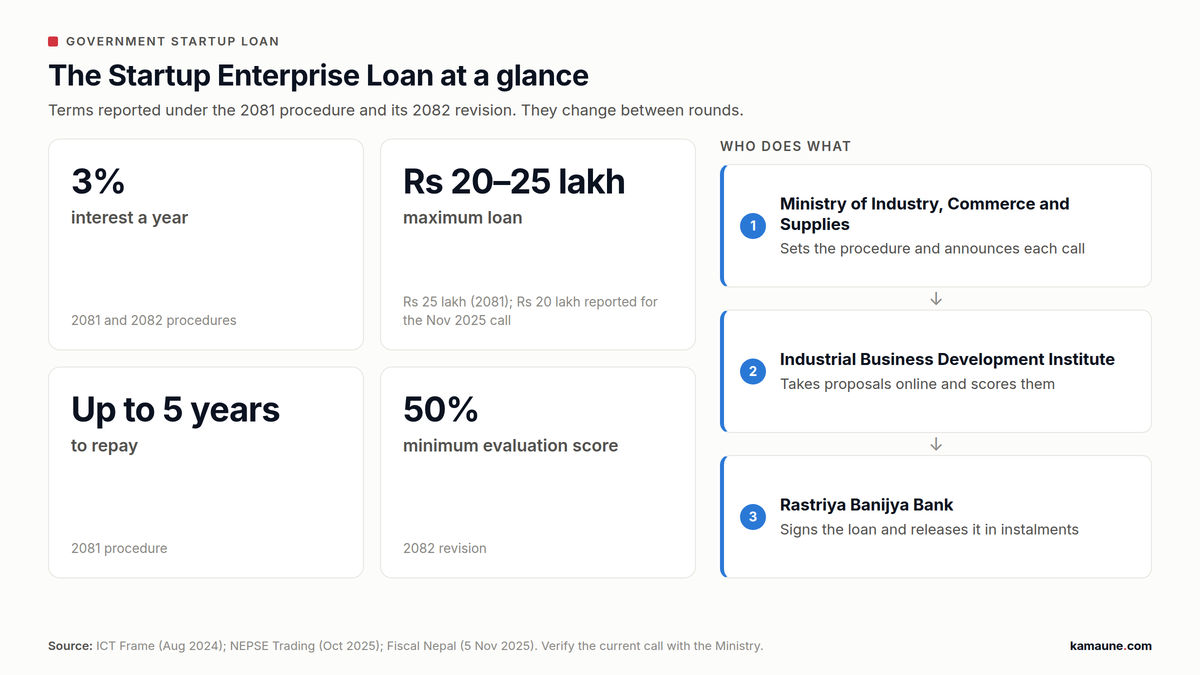
The main government startup loan in Nepal is the Startup Enterprise Loan, a concessional loan at 3% interest for innovative startups. It is issued under a procedure of the Ministry of Industry, Commerce and Supplies, evaluated by the Industrial Business Development Institute and disbursed through Rastriya Banijya Bank. Its terms have changed twice since 2024, so treat everything below as a guide, not a guarantee.
The Startup Enterprise Loan
Point What the published sources say Policy owner Ministry of Industry, Commerce and Supplies (Startup Enterprise Loan Operation Procedure, 2081, approved August 2024) Revision Startup Enterprise Credit Operation Procedure, 2082 (reported October 2025) Interest rate 3% per year Loan amount Up to Rs 25 lakh under the 2081 procedure; the November 2025 call for proposals was reported with a Rs 20 lakh ceiling Security The project itself as collateral under the 2081 procedure Repayment Up to 5 years (2081 procedure) Who qualifies (2081) Enterprises registered for under 10 years, with annual turnover never above Rs 15 crore, showing innovation-led growth potential Who is excluded (2081) Importers of goods/services, blacklisted borrowers, holding/investment companies, and those who already received a concessional loan elsewhere Selection (2082) Proposals are scored on feasibility, innovation, sustainability and socio-economic impact; a minimum of 50% of total marks is required How to apply Online, through the implementing institute's portal, only during an open call. The November 2025 call gave 21 days to apply After approval Selected applicants contact the designated bank (reported as Rastriya Banijya Bank) within 30 days
The 2081 procedure disbursed larger loans in instalments (one instalment up to Rs 5 lakh, two up to Rs 15 lakh, three up to Rs 25 lakh), with later instalments released after verified progress.
What this means for you: the scheme is for innovative startups, not for opening an ordinary retail shop. It opens in rounds, the window is short, and the scoring is competitive. Watch the Ministry and the implementing institute for the next call, and have your business plan ready before it opens.
NRB's subsidised (concessional) loans
Separately, Nepal Rastra Bank runs an interest-subsidy procedure under which banks lend to priority groups, with the government paying part of the interest. A September 2023 unified procedure covered, among others:
Category Limit reported in 2023 Women entrepreneurs Rs 15 lakh Returnee migrant workers Rs 10 lakh Dalit entrepreneurship Rs 10 lakh Educated youth self-employment Rs 7 lakh Commercial agriculture and livestock Rs 5 crore
Under that procedure, the government subsidy was 5–6 percentage points, the bank could charge at most 2 percentage points above its base rate, and repayment ran up to five years. Limits under this procedure have since been revised and newer figures circulate, so ask your bank's SME or concessional loan desk for the current procedure before you plan around a number.
You may also find programmes through your provincial government, the Youth and Small Entrepreneur Self-Employment Fund, or the Cottage and Small Industries Development Board. Their terms vary by year and by province, so check directly with the office concerned.
Startup Loan Eligibility
Startup loan eligibility in Nepal usually depends on five things: a registered business, a credible business plan, a clean credit record, your own investment in the project, and security the lender accepts. Exact rules differ by lender and by scheme.
Factor What lenders usually look for Business registration Registered with the right authority: ward/municipality or the Department of Commerce route for a sole proprietorship, the Cottage and Small Industries office for cottage/small industries, or the Office of Company Registrar for a private limited company Business plan Clear product, market, costs and a realistic repayment source Age or stage Many banks prefer some operating history; schemes like the Startup Enterprise Loan set their own limits (under 10 years old in the 2081 procedure) Credit history No default or blacklisting in the Credit Information Centre (CIC) records Revenue or cash flow For an existing business, bank statements and sales records; for a new one, projections the lender finds believable Identity Nepali citizenship certificate of the proprietor, partners or directors Tax registration PAN, and VAT registration if your turnover or business type requires it Collateral or guarantee Land or building, the project's own assets, a personal guarantee, or a scheme-defined substitute Promoter contribution Your own money in the project; lenders rarely finance 100% of the cost
If you have not registered yet, start with our guide on how to register a business in Nepal. It covers sole proprietorship registration and PAN, which most lenders ask for first.
Your credit record matters even if you have never taken a business loan. Banks check CIC for personal loans, credit cards and any guarantees you signed for others. [INTERNAL LINK: Credit Score and CIC Report in Nepal]
Documents Required for a Startup Loan
Use this checklist when you visit a lender. Each bank has its own form, so ask for its list as well.
Identity and registration
- [ ] Citizenship certificate of the proprietor, all partners or all directors (copies)
- [ ] Recent passport-size photographs
- [ ] Business registration certificate (firm, industry or company)
- [ ] PAN certificate, and VAT certificate where applicable
- [ ] For a company: Memorandum and Articles of Association, share register, board resolution to borrow
- [ ] For a partnership: partnership deed
- [ ] Local-level business or trade licence, and sector licences (food, pharmacy, transport) where required
Plan and finances
- [ ] Business plan or project proposal
- [ ] Cost breakdown with supplier quotations for equipment and setup
- [ ] Financial projections: profit and loss, cash flow, and a repayment schedule
- [ ] Personal and business bank statements (lenders often ask for 6–12 months)
- [ ] Tax clearance or filed returns, if the business has operated for a year or more
- [ ] Rent or lease agreement for the business premises
Security (if asked)
- [ ] Land ownership certificate (lalpurja), land map (naksa) and boundary details (char killa)
- [ ] Building approval documents for any building offered
- [ ] Valuation report from the bank's approved valuer
- [ ] Personal guarantee or third-party guarantor documents
How to Apply for a Startup Loan in Nepal
To get a startup loan in Nepal: define the business, work out how much you need, write a business plan, compare lenders and schemes, prepare documents, apply, pass the credit evaluation, then sign the loan papers and receive the money.
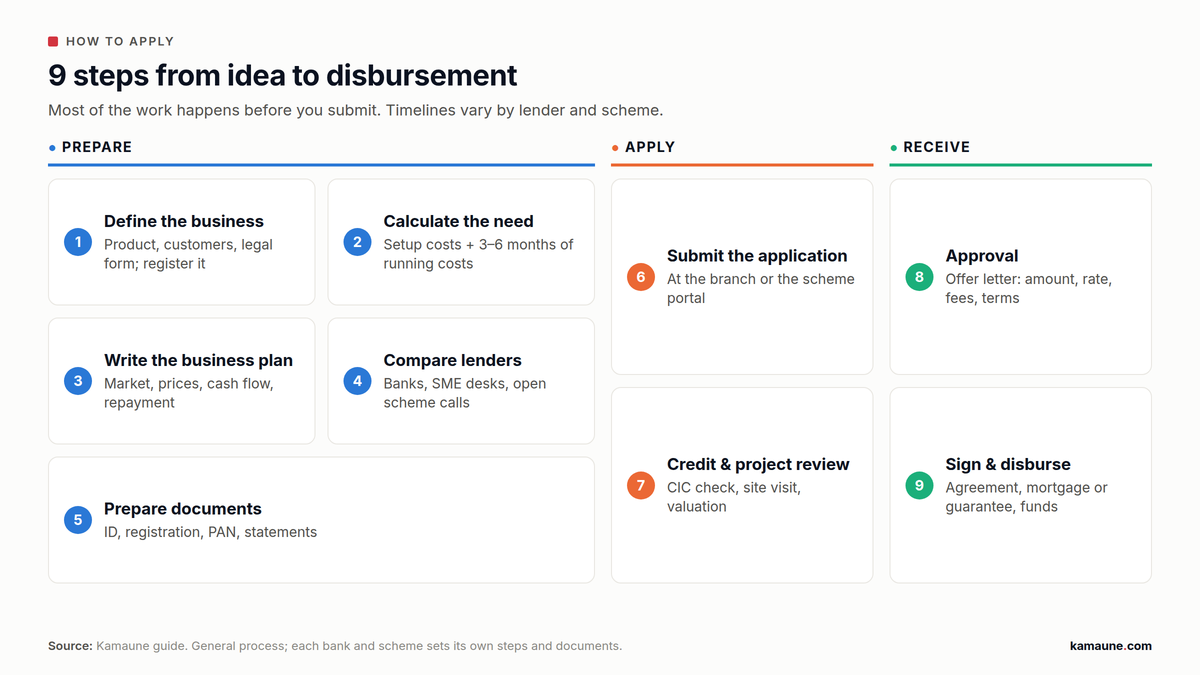
- Define the business. Decide what you will sell, to whom, where and in what legal form. Register it before you apply.
- Calculate your funding requirement. List every setup cost and at least six months of operating costs. Subtract your own contribution. The gap is your loan need.
- Prepare a business plan. Include market research, pricing, monthly cash flow and how the loan will be repaid.
- Compare lenders and programmes. Visit two or three banks, ask about SME and concessional products, and check whether a government scheme call is open.
- Prepare documents. Use the checklist above. Missing papers are a common cause of delay.
- Submit the application. Apply at the branch (or through the scheme's online portal) with the plan and documents.
- Credit and project evaluation. The credit officer reviews your plan, checks CIC, may visit the site and, if collateral is offered, sends a valuer.
- Approval. The bank issues an offer letter with the amount, rate, tenure, fees and conditions. Read it carefully before you sign.
- Documentation and disbursement. Sign the loan agreement, register the mortgage or guarantee, buy any required insurance, then receive the funds, often in tranches tied to progress.
How long does this take? It depends on the lender, the loan size and how complete your file is. A well-prepared SME application can move in a few weeks; collateral valuation and mortgage registration add time. Government schemes follow their own call, evaluation and selection timeline.
How Much Startup Loan Should You Take?
Borrow only the gap between what the business needs and what you can invest yourself, and only an amount whose monthly instalment the business can pay from its expected cash flow, with a buffer.
Work it out in this order:
- Startup costs: equipment, deposits, interiors, registration, first inventory.
- Working capital: at least three to six months of rent, wages, utilities and supplies.
- Monthly expenses: your fixed costs once running.
- Expected revenue: a conservative monthly estimate, built from prices and realistic customer numbers.
- EMI affordability: the instalment must fit inside revenue minus expenses, not inside your hopes.
- Emergency buffer: keep some cash aside for a slow festival season, a repair or a delayed payment.
- Cash-flow cover: many lenders want operating cash flow comfortably above the instalment, not just equal to it.
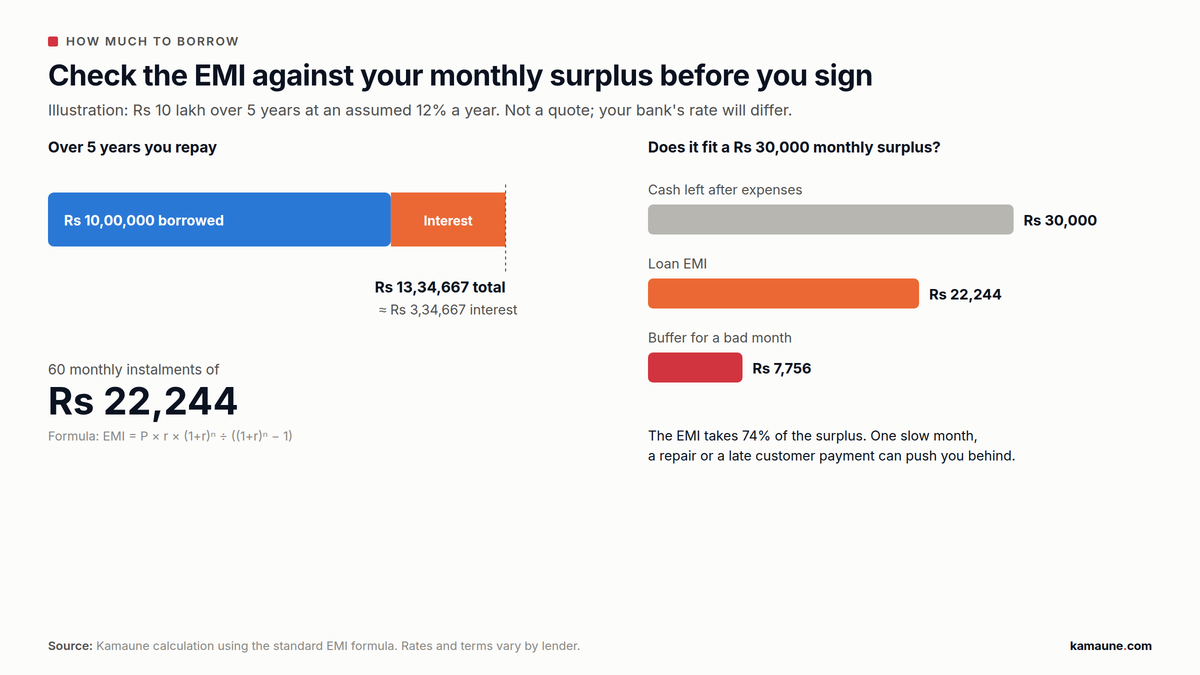
Example (illustration only, not a quote): a Rs 10 lakh loan over 5 years at an assumed 12% annual rate has an EMI of about Rs 22,244. You would repay about Rs 13.35 lakh in total, so roughly Rs 3.35 lakh is interest. If your business expects Rs 30,000 a month after expenses, that EMI leaves very little room for a bad month.
The same discipline you use for a household budget applies here. Our guide on how to make a budget in Nepal shows a simple method you can adapt to a business cash-flow sheet. For the formula and a worked table, see [INTERNAL LINK: How to Calculate EMI in Nepal].
Startup Loan Interest Rates and Charges
The startup loan interest rate in Nepal is usually the bank's base rate plus a premium, so it changes over time. Concessional schemes can be far cheaper, such as the 3% government startup loan. Fees, insurance and valuation costs add to the total.
What to check on every offer:
Cost item What it is Question to ask Interest rate Usually base rate + premium for most bank loans What is today's base rate and my premium? How often is it reset? Fixed vs variable Most Nepali bank loans float with the base rate; some offer a fixed period Can it change during the loan, and how will I be told? Processing or service fee One-time fee, often a percentage of the loan What is the exact amount? Valuation fee Paid to the valuer when collateral is offered Who pays, and how much? Legal and mortgage costs Registration of mortgage at the Land Revenue Office, documentation Which costs fall on me? Insurance Insurance on the collateral, stock or borrower may be required Is it mandatory, and can I choose the insurer? CIC report fee Charge for pulling your credit report Is it included in other fees? Prepayment charges Fee for paying off early or switching banks Is there a penalty, and for how long?
Banks in Nepal publish their base rate and interest rates on their websites each month, and NRB regulates how they are set. Compare offers on the total cost of the loan, not just the headline rate. Rates are not listed here because they change monthly and differ by bank and borrower.
Collateral-Free Startup Loans
A collateral-free startup loan does not require land or a building as security. In Nepal it is available mainly through concessional schemes and small loans, and it is not risk-free: you still repay in full, and the lender can recover from you, your business or a guarantor.
What "collateral-free" usually means in practice:
- Project as collateral: the assets bought with the loan, such as machinery or stock, are the security. The 2081 Startup Enterprise Loan procedure used this model.
- Personal guarantee: you, a partner or a family member sign to repay if the business cannot.
- Group guarantee: common in microfinance, where members guarantee each other.
- Credit guarantee: a guarantee institution or scheme covers part of the bank's risk, where available.
"Collateral-free" does not mean "risk-free". A default can still lead to recovery of business assets, legal action on a guarantee and a blacklist entry in CIC that blocks future borrowing. Also expect a stricter plan review and a smaller amount than a secured loan.
Startup Loan vs Personal Loan
Some founders take a personal loan because it seems faster. Here is how the two compare:
Point Startup or business loan Personal loan Purpose Business setup, assets, working capital Personal needs; using it for business may break the loan terms Eligibility Business plan, registration, project viability Your salary or personal income Interest Business rate; concessional options exist Often higher for unsecured personal loans Documentation More: plan, registration, projections Less: ID, salary or income proof Repayment Can be structured around business cash flow, sometimes with a grace period Fixed EMI from your personal income Business credit Builds a credit record for the business Builds only your personal record Risk Tied to the business and any guarantee Entirely on you, whether or not the business works
A personal loan can make sense for a very small, low-risk start funded mostly by savings. For anything larger, a business loan is the cleaner structure. [INTERNAL LINK: Personal Loan in Nepal]
Startup Loan vs SME/Business Loan
In everyday use the terms overlap: most "startup loans" from Nepali banks are SME loans given to a new business. The difference is mainly in how the lender judges you.
Point Startup loan SME / business loan Business stage New or early stage, little or no trading history Operating business with records Main basis for approval Business plan, projections, promoter's skills and contribution Past financial statements, tax returns, bank turnover Collateral Often needed; concessional schemes may accept project assets Usually land, building or business assets Loan size Usually smaller Larger, linked to turnover and security Interest Market rate or concessional (e.g. the 3% government scheme) Base rate plus premium Repayment May include a grace period while the business ramps up Regular EMI or a revolving working-capital limit Typical products Project loan, concessional startup or youth loan Term loan, overdraft, working-capital loan, trade finance Best for Launching Growing an existing business
Once your business has a year or two of clean accounts, an SME loan in Nepal usually becomes easier to get, and on better terms, than a first-time startup loan.
How to Prepare a Strong Business Plan for Loan Approval
A loan-ready business plan proves three things: there are paying customers, the numbers work, and the loan can be repaid from the business's cash flow. Keep it short, specific and based on evidence. A 10–15 page plan with real quotations beats a 60-page template.
Section What to include Executive summary One page: the business, the loan amount, your contribution and the repayment source Problem and solution The customer problem in your area and how you solve it Market analysis Size of the local market, demand evidence, seasonality (Dashain–Tihar, wedding season, monsoon) Target customers Who buys, where they are and how often Competitor analysis Nearby competitors, their prices and your advantage Business model What you sell, at what price and margin, and how customers pay (cash, QR, credit) Marketing strategy Launch plan, channels and cost per customer Operations Location, suppliers, equipment, staff and licences Management and team Your experience, partners and any advisers Financial projections Three years of projections, monthly cash flow for year one, then quarterly or yearly; a profit and loss; a break-even point Loan requirement Total project cost, your contribution, loan amount and itemised use of funds Repayment plan EMI schedule against projected cash flow, with a worst-case scenario
If you are building an e-commerce or digital business, our guide on how to start an online business in Nepal helps you shape the operations and marketing sections.
Common Reasons Startup Loan Applications Get Rejected
- Weak business plan: generic text with no local market evidence or real quotations.
- Unrealistic projections: sales that double every month, or profit from month one.
- Poor credit history: overdue credit cards, past defaults or a blacklist entry in CIC.
- Insufficient documentation: missing registration, PAN or land papers, or mismatched names across documents.
- Lack of repayment capacity: projected cash flow too thin to cover the EMI.
- Unclear use of funds: a lump-sum request with no itemised breakdown.
- Inadequate promoter contribution: asking the bank to carry nearly all the risk.
- Regulatory or compliance issues: missing sector licences, the wrong registration type, or an activity a scheme excludes.
Tips to Improve Your Chances of Getting a Startup Loan
- Register properly first, and keep names identical across citizenship, registration, PAN and bank account.
- Run business money through a bank account from day one. Statements are evidence. Digital payments through QR and wallets also leave a record.
- Put in a meaningful share of your own money. It shows commitment and lowers the lender's risk.
- Clean up your personal credit: clear overdue amounts before you apply.
- Use real quotations for equipment and fit-out instead of estimates.
- Start smaller. A smaller first loan repaid on time makes the next one easier.
- Talk to the SME desk early, before you sign a lease. Ask what they need to see.
- Show relevant experience: training certificates, past jobs in the sector, or a mentor or partner who has done it.
- Prepare a worst-case scenario that still covers the EMI.
- Watch for scheme calls for the government startup loan and concessional loans, and have your file ready before the window opens.
Mistakes to Avoid When Taking a Startup Loan
- Borrowing more than you need. Every extra lakh carries interest and adds to your EMI.
- Ignoring interest and fees. Compare the total cost, including processing, valuation, insurance and legal charges.
- Using business loans for personal expenses. It can breach your loan terms and starves the business of cash.
- Unrealistic revenue projections. If you fool the bank, you also fool yourself about what you can repay.
- Ignoring repayment planning. Know your EMI dates and keep at least one or two instalments in reserve.
- Choosing a lender only on the interest rate. Speed, flexibility, grace period and branch support also matter.
- Not reading the loan terms. Check rate-reset clauses, prepayment charges, default penalties and what happens to your collateral or guarantee.
Startup Financing Alternatives
Startup funding options in Nepal beyond loans include bootstrapping, friends and family, angel investors, venture capital, grants, incubators and strategic investors. Many founders combine two or three.
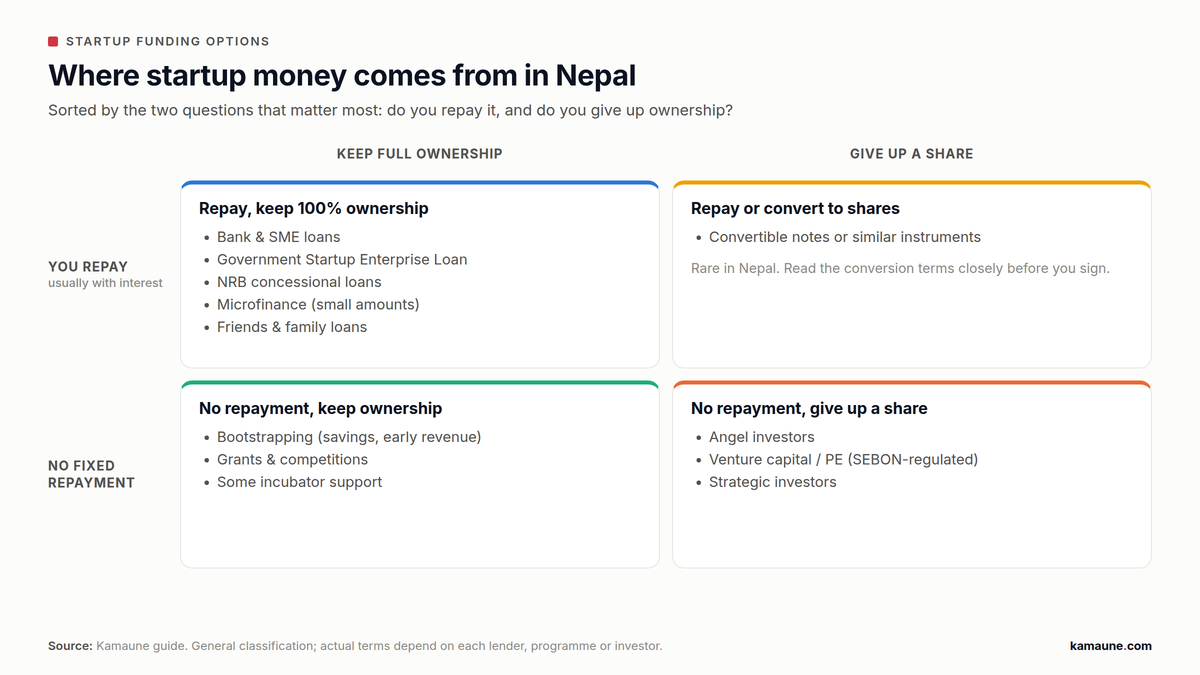
Option How it works Good to know Bootstrapping Fund the business from savings and early revenue Slow but keeps control; see our guide on how to save money in Nepal to build your starting fund Friends and family Informal loans or small stakes from people you know Put terms in writing to protect relationships Angel investors Individuals invest their own money for equity Active mainly in Kathmandu tech and consumer startups; expect to give up a share Venture capital and private equity Funds invest larger amounts for equity For scalable businesses; in Nepal, PE/VC funds are regulated by SEBON Grants Non-repayable funds from government, donor projects or competitions Competitive, tied to conditions and reporting Incubators and accelerators Mentorship, workspace and sometimes seed money Useful for first-time founders; read any equity terms Crowdfunding Raising small amounts from many people Equity crowdfunding has no clear legal framework in Nepal; donation or pre-order models are more practical Strategic investors A business in your sector invests for a partnership or supply link Brings expertise and customers; watch control terms
If you are still building savings before you start, our guide to personal finance in Nepal covers the basics of managing money first.
Frequently Asked Questions
What is a startup loan in Nepal?
A startup loan in Nepal is money borrowed to start or run a new business, repaid with interest over a fixed period. It can be an SME or project loan from a bank or financial institution, or the government's concessional Startup Enterprise Loan for innovative startups.
How can I get a startup loan in Nepal?
Register your business, prepare a business plan with costs and cash-flow projections, and approach two or three banks or development banks. Apply with your documents, pass the credit and project evaluation, then sign the loan agreement. For the government scheme, apply online during an open call.
Who is eligible for a startup loan?
Usually a Nepali citizen with a registered business, a viable plan, a clean credit record and some of their own money in the project. Each lender and scheme sets its own rules. For example, the 2081 government procedure limited eligibility to enterprises under 10 years old with turnover not above Rs 15 crore.
Can I get a startup loan without collateral?
Sometimes. The government startup loan has accepted the project itself as collateral, and small loans may rely on personal or group guarantees. Most regular bank loans for new businesses still ask for land, buildings or other security.
What documents are required for a startup loan?
Citizenship certificates, business registration, PAN (and VAT where applicable), a business plan with projections, bank statements, and company or partnership documents. If you offer collateral, add land ownership papers and a valuation report.
How much startup loan can I get?
It depends on your project cost, your own contribution, your repayment capacity and the security you offer. The government Startup Enterprise Loan has been capped at Rs 20–25 lakh depending on the round; bank loans are set case by case.
What is the interest rate on startup loans?
Bank loans are usually priced at the bank's base rate plus a premium, which changes monthly. The government startup loan has been offered at 3% a year. Check each bank's published rates and ask for the total cost, including fees.
Can a new business get a bank loan in Nepal?
Yes, but it is harder than for an established business. Banks want a strong plan, your own investment and usually collateral or a guarantee. Concessional loan windows for women, youth and returnee migrants can help eligible borrowers.
Is a government startup loan available in Nepal?
Yes. The Ministry of Industry, Commerce and Supplies runs the Startup Enterprise Loan at 3% interest, with applications evaluated by the Industrial Business Development Institute and loans disbursed through Rastriya Banijya Bank. It opens in rounds, so check for the current call.
What is the difference between a startup loan and a business loan?
A startup loan is approved mainly on your plan and future cash flow because the business has little history. A business or SME loan is approved mainly on past accounts, turnover and collateral.
How long does startup loan approval take?
There is no fixed timeline. A complete bank application can take a few weeks, and collateral valuation and mortgage registration add time. Government schemes follow their own call, evaluation and selection schedule, which can take months.
Conclusion
A startup loan in Nepal is within reach if you treat the application the way a credit officer does: a registered business, a believable plan, your own money on the line and an EMI the business can carry in a bad month. Compare banks on total cost, watch for the next government startup loan call if your idea is genuinely innovative, and borrow only the gap you cannot fill yourself.
Want more practical guides on starting and growing a business in Nepal? Join the Kamaune newsletter.
This article is educational, not financial or legal advice. Interest rates, loan limits, eligibility rules and government schemes change. Verify current terms with the relevant bank, financial institution, Nepal Rastra Bank or the implementing government agency before you act.