
Updated 15 October 2026. Status checked against news reports up to this date.
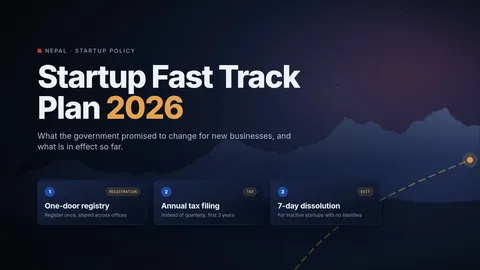
Nepal's Startup Fast Track Plan 2026 is the government's attempt to cut the paperwork that slows down new businesses. It promises one online registration every office can read, yearly tax filing for young startups, faster concessional loans, and a seven-day exit for startups that never took off. The Ministry of Industry, Commerce and Supplies (MoICS) introduced it in June 2026 as part of the government's 100-point governance reform agenda, Fiscal Nepal reported.
Four months on, most of it is still a promise. Here is what the plan contains, what has started, and what you can do today.
What is Nepal's Startup Fast Track Plan 2026?
The plan is an action plan, not a new law. The Kathmandu Post calls it the Startup Fast Track Working Plan 2026; Nepali media call it the स्टार्टअप फास्ट ट्र्याक कार्ययोजना (Startup Fast Track Action Plan). It assigns tasks to the offices a startup deals with, from the Office of the Company Registrar to local governments and the Industrial Enterprise Development Institute (IEDI).
It builds on the National Startup Enterprise Policy approved in 2024 and on a 2025 amendment to the Industrial Enterprise Regulation that gave "startup" a legal definition: a business stops counting as a startup after ten years or once annual transactions pass Rs 15 crore. Its four aims are faster registration, lighter compliance in a startup's first three years, quicker access to finance, and an easy exit for startups that stop operating.
The plan took effect on introduction, with a three-month deadline to start the legal changes it needs.
Key changes for startups in Nepal
Some items are directives agencies can act on now; others need new laws or software. Status is as of 15 October 2026.
Change What it means for you Status One Door Business Registry Platform Register once; details auto-fill across government systems, so you stop resubmitting documents Planned (being added to the existing Electronic Information Management System) Startup Focal Persons Each local government names a facilitator to help startups Directed (instructions sent to local governments) Tax clearance in 7 days Tax clearance certificates issued within seven days Directed Annual tax filing File tax details yearly, not quarterly, for the first three years Planned (needs a legal change) Faster concessional loans Quicker processing of the subsidised startup loan, plus help desks at the Company Registrar and IEDI Planned IEDI support services Coaching, mentoring, business clinics and boot camps for certified startups Planned 7-day dissolution Close within seven days if you have no employees, no liabilities and no transactions for three years Proposed law
Tax rules: until the law is amended, a startup still files every quarter like any other business. Solo freelancers follow separate rules; see how freelancers pay tax in Nepal.
Loans: the plan sets no new loan amounts or rates; it aims to speed up the existing scheme. About 1,500 entrepreneurs received around Rs 1.88 billion in subsidised loans over the past three fiscal years, Kathmandu Post reports, but approvals have taken months, sometimes over a year. Current terms are in our startup loan guide for Nepal.
How the plan could help new entrepreneurs
If the government delivers, three things get easier:
- Less time in government offices. If the tax office, ward and province read one registration record, the most common delay disappears.
- Lower costs before revenue. One tax filing a year means fewer deadlines and lower accountant fees while you test the idea.
- A cheaper way to fail. A seven-day exit lets a founder close a dead company and start again, instead of carrying an empty registration for years.
The registration process itself has not changed yet. If you are starting now, follow the current steps for registering a business in Nepal, get your PAN, and keep clean records from day one.
Keep expectations realistic: the subsidised loan scheme announced in 2018 took five years to start working. "Unless the government makes financing easier, most of these plans will remain on paper," Saroj Kaji Shrestha, president of the Kavre Yuva Udhyami Forum, told the Kathmandu Post. The three-month deadline for legal changes passed in September, and we found no public record that the tax or dissolution amendments have been tabled.
Frequently Asked Questions
What is the Startup Fast Track Plan 2026?
It is an action plan the Ministry of Industry, Commerce and Supplies introduced in June 2026 to make starting a startup easier. It covers one-door digital registration, annual tax filing for the first three years, faster concessional loans, and seven-day closure for inactive startups.
How can I register a startup in Nepal?
For now, register like any other business: as a private firm, partnership or company with the relevant authority, then get a PAN from the Inland Revenue Department. To use startup programmes such as the concessional loan, the business must also meet the legal startup definition, including being under ten years old.
Does the government offer startup loans?
Yes. The government runs a concessional startup loan at 3% interest, opened through periodic calls for proposals. The Fast Track Plan aims to speed up approval and disbursement but does not change the terms.
Are the new startup rules already in effect?
Mostly not. The plan is in effect and some directives, such as seven-day tax clearance and local Startup Focal Persons, can apply now. As of 15 October 2026, annual tax filing and seven-day dissolution still need legal amendments, and the One Door platform is still being built.
Conclusion
The Startup Fast Track Plan 2026 targets the right problems: duplicate paperwork, heavy early compliance and slow loans. Until the platform launches and the laws change, starting a business works as it did before June. We will update this article when that happens.
Still deciding what to build? Start with these low-investment small business ideas in Nepal, and join the Kamaune newsletter to hear when the rules change.
This article is educational, not financial or legal advice. Rules, rates, and fees change — verify with the relevant official source or a qualified professional before acting.